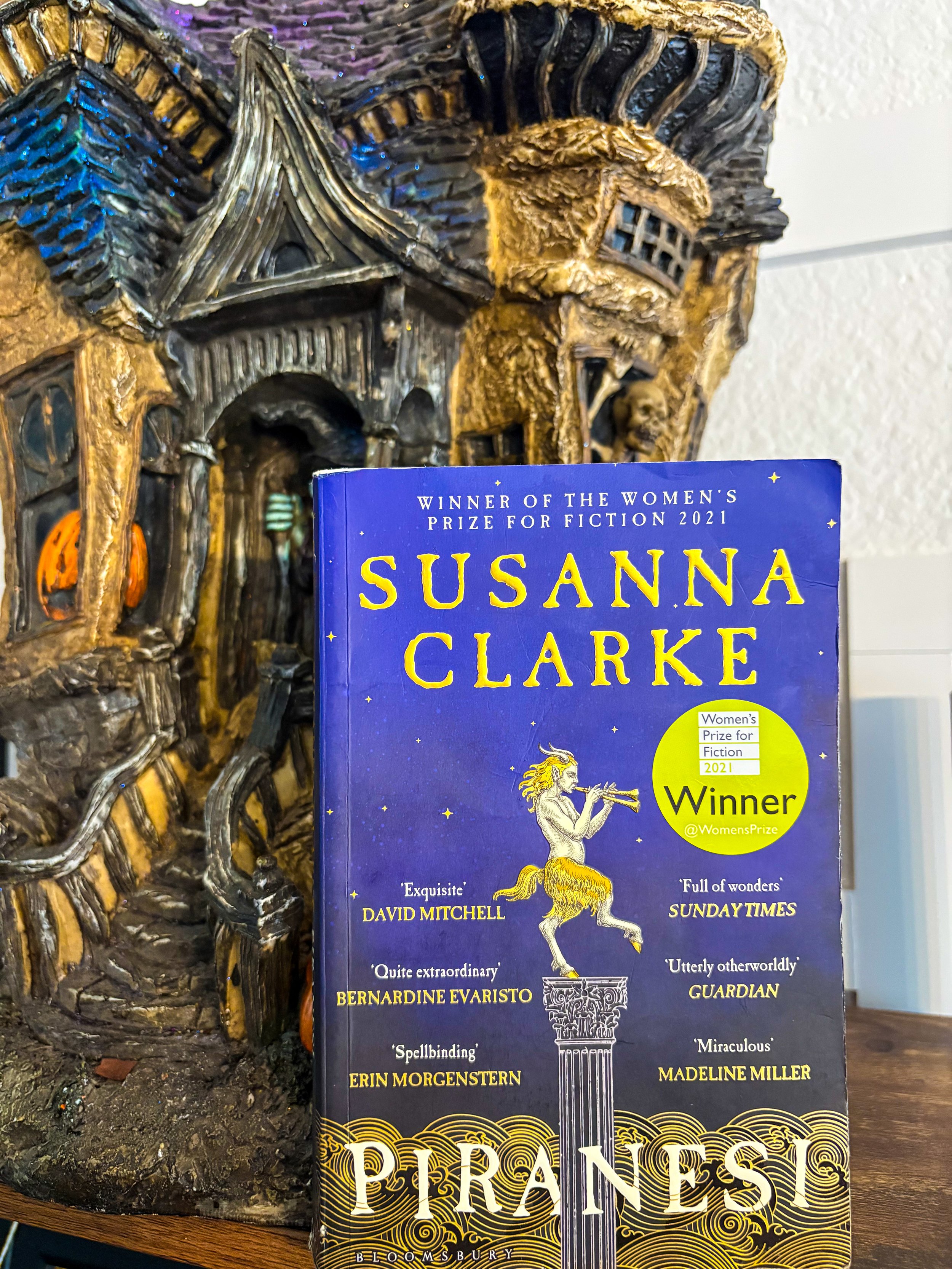
Piranesi Book Review by Susanna Clarke
I needed this book.
Not because it’s the best thing I’ve ever read, but because of what I read right before it.
My last two reads were The Curious Incident of the Dog in the Night-Time (5/10) and Oleander (4/10). That’s two misses in a row: one left me feeling nothing, and the other left me feeling everything except joy. I was in desperate need of something I actually liked.
Enter Piranesi, a nifty, crafty little book by Susanna Clarke that was weird and strange in exactly the way I needed at the time.
And I do mean weird.
Piranesi is narrated by a man named, well, Piranesi (although he’s fairly sure that isn’t his real name). He lives in the House, an endless labyrinth of marble halls lined with thousands of enormous statues.
The lowest halls are flooded by an ocean whose tides crash through the corridors, and the highest halls are lost in the clouds. In between are vestibules, staircases, and rooms leading to other rooms, seemingly forever.
Piranesi adores it. He explores, he fishes, he records the tides and the statues in meticulous journals, and he lovingly tends to the skeletons of the dead he’s found scattered throughout the halls.
As far as Piranesi knows, only fifteen people have ever existed: himself, thirteen people who are now bones, and the Other.
The Other is a well-dressed man who meets with Piranesi twice a week and enlists his help in searching for a Great and Secret Knowledge supposedly hidden somewhere in the House.
Piranesi is happy to help. Piranesi is happy about almost everything, honestly.
Then the cracks start to show. Piranesi finds entries in his own journals that he doesn’t remember writing. Evidence appears of a sixteenth person in the House. And the Other begins warning him that if this new person ever speaks to him, they will drive him mad.
From there, the book turns into a mystery about who Piranesi really is, what the House actually is, and how he got there in the first place. I won’t spoil any of it, because piecing it together yourself is half the fun.
First things first: the setting.
The moment I stepped into the House, I was hit with déjà vu. Tunnels leading to other tunnels leading to rooms leading to strange places?
That’s The Starless Sea by Erin Morgenstern, a book I gave a 4/10 and one that made me feel like I was drowning in honey.
So yes, I was nervous.
Thankfully, the similarities mostly end at the architecture. The Starless Sea had an incredible setting and absolutely no discernible plot. Piranesi has the incredible setting and an actual mystery driving it forward.
The strangeness isn’t there just to be strange. It’s there because something is genuinely wrong, and the further Piranesi wanders, the more you want to know what it is.
There’s also no honey. No bees, no keys, no owls, no swords. Clarke never beats you over the head with a symbol, which, after The Starless Sea, felt like a gift.
Which brings me to the biggest strength of this book: it was fun.
It kept me hooked from beginning to end, and it constantly went in directions I didn’t see coming. Every time I thought I had a handle on what kind of book this was, Clarke took a sharp turn down some new hallway and I had to rethink everything.
That’s no small thing. Plenty of books with “strange” premises start strong and then settle into something predictable by the halfway mark (or, in Morgenstern’s case, never figure out where they’re going at all). Piranesi never really settles. It stays odd the whole way through, and I mean that as a compliment.
The creativity alone is worth the read. A house that is a world, with an ocean inside it and statues standing in for landmarks, narrated by a man who treats all of it with total wonder and reverence? I’ve never read anything quite like it.
Speaking of Piranesi himself, unlike Zachary Ezra Rawlins (sorry, I had to), I actually started to care about him. He’s earnest, gentle, and endlessly curious, and he capitalizes words like Halls and Tides and Statues as though they’re sacred (which, to him, they are). He sees beauty in everything, even when the reader can tell something is deeply off.
And that brings me to my biggest gripe: I wish this book was longer.
By the time I was really starting to get attached to Piranesi, the book was over. Just like that. I was finally invested in him, in the House, and in the mystery, and then I turned the page and there was nothing left to turn.
I needed more time. More depth. More history.
Give me more of the House itself. How did it come to exist? What else is out there in the halls Piranesi hasn’t explored? Who were the dead before they were bones?
Let me sit with Piranesi a little longer after everything comes to light, instead of rushing to the finish line.
There’s a whole world here that’s only been sketched in, and I wanted to delve into it so badly.
But that’s not what this book was, and to be fair to Clarke, it’s not trying to be. Piranesi is deliberately small and contained. It’s a short, strange puzzle box, not an epic.
Is that a flaw? Kind of. Is it a deal-breaker? No. But it is the reason this book stops short of being great for me.
The other issue is a little harder to pin down. I enjoyed Piranesi by the end, I truly did. But as time has passed, I’ve realized I haven’t thought about it much since I finished it.
Some books follow you around for weeks. Piranesi didn’t. It was a lovely, odd little experience while I was in it, and then it was over and I moved on.
Unlike Oleander, I don’t think about it with rage. I just don’t think about it much at all.
I think that comes back to the length. I didn’t spend enough time in this world for it to really sink its hooks into me. If I’d gotten more depth, more history, and more time with Piranesi, I think it would have left a mark.
As it stands, Piranesi was fun, creative, and exactly what I needed at the time. It just didn’t leave a dent.
Recommendation: If you’re in a reading slump and need something short, strange, and genuinely creative to get you out of it, Piranesi is perfect.
If you liked the setting of The Starless Sea but wished it had an actual plot, this is the book for you. If you’re looking for a deep, sprawling world with tons of lore and history to sink into, you’ll probably finish it wanting more, just like I did.
Score: 7/10 (for pure creativity, even if it didn’t stick with me)


