Oleander
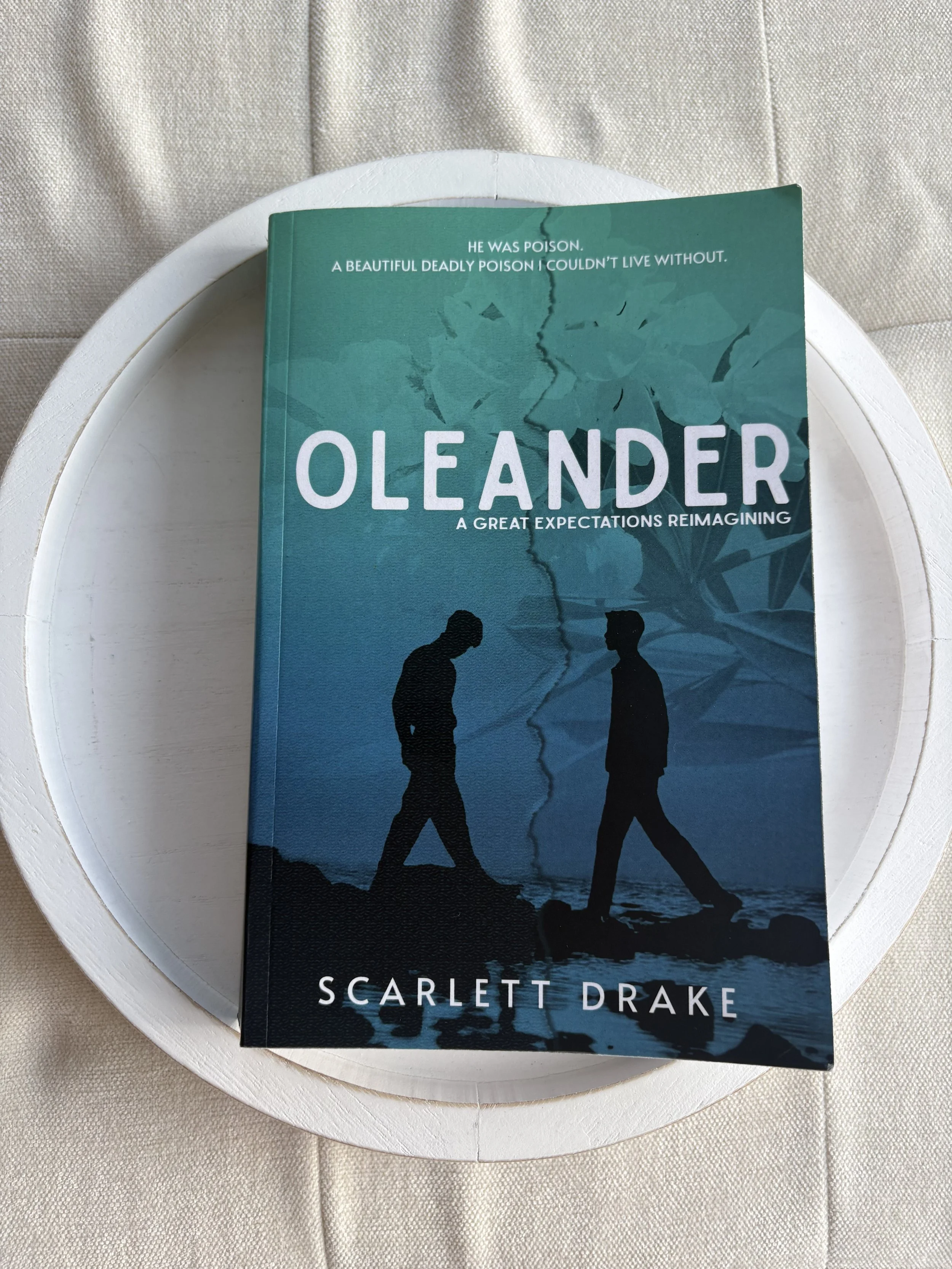
Oleander Book Review by Scarlett Drake
I wanted a gay Great Expectations. I got a total slog of 600 pages filled with a boy pining over one idiotic summer.
Oleander is a contemporary, queer reimagining of Dickens, which is a great pitch. Unfortunately, I’ve never read Great Expectations, so I can’t judge this as an adaptation. I did my homework afterward though, and I’ll get to the comparison later.
The story is narrated by Jude Alcott, an orphan raised by his sister, who is horrible, and her husband, Luke, who is technically his brother-in-law but is basically his stepdad.
Luke runs a gardening business, and the summer Jude turns fifteen, he helps Luke tidy up the grounds of the Deveraux estate, a sprawling, stereotypical brooding mansion.
There he meets Caspien Deveraux: gorgeous, ice cold, wildly superior, and armed with a razor-sharp tongue. Caspien is also an orphan (of course), living there with his eccentric uncle Gideon.
Jude hates him on sight. Jude also can’t stop thinking about him, so much so that he tries dating Ellie, one of the most popular girls at school, to shake the feeling (It doesn’t work and it only shows how much of an asshole Jude really is.)
They have one good summer together, and then Caspien breaks his heart for the first time.
That’s the foundation for the next thirteen years and the entire rest of the book.
From there, the book follows Jude from his teens into adulthood, hopping from the Channel Islands to Oxford to London. Caspien keeps hurting him, Jude keeps going back, and other love interests come and go.
The book opens with a prologue hinting at where it all ends up, and the whole story is in Jude’s first-person POV. Only the epilogue switches to Caspien.
Which is a problem, because Jude is completely insufferable.
I spent the whole book inside the head of a boy who whines and pines for someone who treats him like shit. We’re also told Jude is smart, which made no sense to me because he is the dumbest person on the planet.
And the pining is the real issue. Who is still hung up thirteen years later on someone they spent one summer with at fifteen? He’s “ruined” for everyone else? It’s pathetic, it’s irritating, and honestly, he should see a psychologist.
Even worse, the “romance” barely exists, because THEY ARE NEVER ACTUALLY TOGETHER. They hardly spend any time together in the entire book. How am I supposed to buy an epic, life-defining love story when the couple is almost never in the same room?
And then we’re handed a happy ending between two people don’t even know each other other than having rough BDSM like sex.
Caspien isn’t any help either. He treats Jude terribly and is a martyr for literally no reason. I hated him too.
Everyone else in the book is forgettable. Luke, the horrible sister, the friends, the family, the other love interests: none of them matter. Gideon is a caricature of a character at best.
The book also tries to make Jude and Caspien feel “real” and relatable through their late-night conversations about Ghibli movies.
It doesn’t work. It felt like an author self insert, not two people getting to know each other. And then there are all the lines about Caspien being “girlish,” which sent me into an early grave.
Now, the homework. From what I can tell, Drake mapped her cast pretty closely onto Dickens. Jude is Pip, a poor orphan narrating his own story, hopelessly in love with a cold, beautiful person.
Luke and the horrible sister line up with Joe Gargery and the sister who raised Pip. Caspien takes Estella’s role, raised by a bitter guardian in a big, brooding house, so Gideon is Miss Havisham.
The blurb even says Caspien was “cultivated and nurtured by a careful hand and a bitter heart,” which is basically Miss Havisham raising Estella to be hard-hearted. Readers say it’s a pretty faithful retelling, down to the mystery benefactor.
Where it differs is the genre. Great Expectations isn’t a romance. It’s about class, snobbery, and being ashamed of where you come from. Drake packaged hers as a romance, swapped the Estella role to a boy, moved it to the present day, and gave it a happy ending Dickens never promised.
I also found it so jarring that this is a contemporary retelling. These characters did not work in the modern world at all. Drake’s writing didn’t help. It was redundant and juvenile, hitting the same emotional beats over and over until they meant nothing to me.
The sex scenes were boring, repetitive, and, like everything else in this book, unbelievable.
And the length. This book could have been way shorter. It was a total slog to get through, and it only got a littleee better toward the end because I was nearly done and wanted to see how the drama would wrap up. By then I hated every character in it.
I learned my lesson with this one: read the original Great Expectations instead of this trash.
Recommendation: If you love angsty, decade-spanning, heartbreak-on-repeat romances, you may get far more out of this than I did (plenty of readers clearly do). If you need a main character with a spine, a couple who are actually together, and a book that knows when to end, skip it. And if you want the story itself, go straight to Dickens.
Score: 4/10


