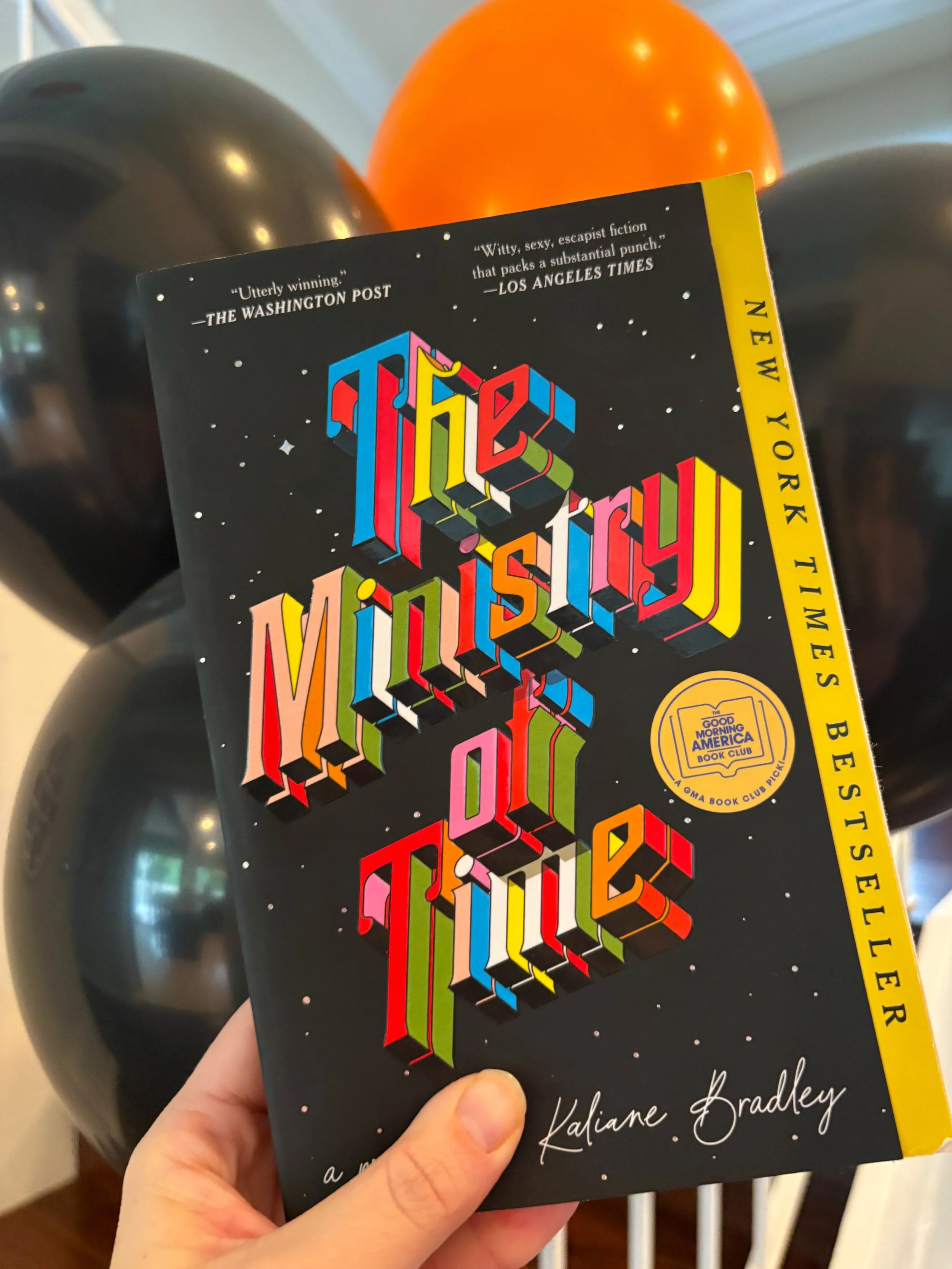
The Ministry of Time Book Review by Kaliane Bradley
This review was supposed to be a 7/10.
Then I started actually thinking about this book, and well, here we are.
The Ministry of Time is Kaliane Bradley’s debut novel, and it has one of the most fun premises I’ve read in a while. In the near future, the British government gets its hands on a time door and uses it to pull people out of history moments before they would have died.
These time travelers, politely labeled “expats” rather than refugees, are each assigned a “bridge,” a civil servant who lives with them and helps them adjust to the modern world.
Our narrator, an unnamed British-Cambodian civil servant, is assigned to Commander Graham Gore, a Victorian naval officer plucked from the doomed 1845 Franklin expedition to the Arctic. (Fun fact: Bradley came up with the idea while watching The Terror, the TV show about that very expedition.)
The other expats include Maggie, a woman pulled from the 1665 plague, and Arthur, a soldier from the Battle of the Somme in 1916, along with their bridges, including Simellia, Arthur’s bridge. Overseeing all of them are the narrator’s handler, Quentin, and Adela, the Ministry’s mysterious Vice Secretary.
What starts as a quirky fish-out-of-water story slowly turns into something more dangerous. Strange figures begin lurking around the Ministry, the narrator realizes something within it is very wrong, and she has to figure out who to trust while falling harder and harder for the man she’s supposed to be supervising.
Part time travel romance, part spy thriller, part workplace comedy. On paper, it should have been a slam dunk for me.
And at the start, it was. I really, really liked this book.
First things first: the narrator.
She feels distinct, and more importantly, she’s not perfect. She has real, genuine flaws. She gets jealous. She messes up conversations with other people constantly, like when she randomly drops the bomb about Auschwitz on Gore.
She stumbles through conversations about race and race relations with Simellia. She doesn’t know who to trust between Adela and Quentin.
But she’s also confident in her skills and adept in a lot of different capacities. She’s competent without being flawless, which is exactly the kind of main character I love.
I’ve said it before and I’ll say it again: give me characters with real flaws over perfect, shiny protagonists any day of the week.
Which, unfortunately, brings me to Gore.
Gore, at times, seemed a little too perfect. He’s smart, charming, a good shot, a good person, etc. You name it and he’s got it. Compared to the narrator, who stumbles and fumbles her way through half the book, Gore glides through almost everything with a smirk and a cigarette.
Is he likable? Absolutely. Is he complex? Not really.
Speaking of the premise, my favorite part of this book by far was the bridges teaching the expats about the modern world. I am fascinated by this idea. Gore having to learn about television, women’s rights, gay rights, global warming, all of it, is amazing. Imagine going from a frozen ship in 1847 to a London flat with a TV remote.
That was the book I wanted. Unfortunately, it’s not the book I got for very long.
Here’s where the criticisms start to come in.
All the expats adapted too quickly. I wanted so much more of the book to be about Gore, Maggie, Arthur, and the others learning about the current year and struggling to adapt. But low and behold, Maggie is on Tinder in no time. Suddenly everyone loves movies and Spotify and going to bars.
It just seemed…fast.
These are people who saw the plague, the trenches, and the Arctic. They should be overwhelmed. They should be confused, scared, maybe even angry. Instead, the adjustment period is skipped over like an inconvenient montage.
Let me see them struggle. Let me see Maggie figure out what a dating app even is before she’s swiping on one. That’s where the heart of this premise is, and Bradley rushes right past it.
Then the middle of the book enters a slog.
It focuses so much on the narrator’s work itself, and it all felt so repetitive. Write a report. Go to the Ministry to meet with Adela. Have shooting practice or a self-defense class. Write emails that bounce back. Repeat.
I understand the workplace comedy angle, but there’s only so many times I can read about the narrator filing paperwork before my eyes glaze over.
I also felt like Bradley wanted to say a lot about race and ended up saying nothing about it.
The pieces are all there. The narrator is the daughter of a Cambodian refugee working for a ministry that refuses to call the people it rescues refugees. Simellia constantly pushes her on it.
There are clearly ideas about colonialism and empire running underneath this whole book. But none of it ever comes together into a real statement. The conversations happen, the narrator fumbles them, and then we move on to the next report.
The throughline of the whole book, of course, is the romance, and I did like it.
However, I never understood why Gore liked the narrator, or “little cat,” as he calls her. I get why she likes him. He’s charming, handsome, and basically perfect (see above). But why does he like her? It’s never made super clear.
On top of that, the romance focuses much more on sex and their physical relationship than anything else, which makes no sense considering Gore’s background and original time period. This is a Victorian naval officer. Where’s the hesitation? Where’s the culture shock?
The more I think about it, the more I realize that while I did like them together, Bradley never really made it make sense for why they liked each other or how it worked, other than a Stockholm syndrome type of deal. She’s his bridge. She’s also basically his entire world in this new time. That’s not exactly an even playing field for a romance.
Spoiler warning for the rest of this review, as I’ll be discussing the ending in detail.
The ending was chaotic. Adela reveals herself to be the narrator from the future, there’s a whole fight with Salese and the Brigadier, and the time door gets involved.
While it was fun, it was also confusing as hell. So much happens so quickly that I had to stop and reread several pages just to figure out who was shooting at whom and why.
And then the end end seemed a bit much for me.
Gore is so, so upset with the narrator for not telling him about the chip in his neck, and while I get it, it also seems extreme. Yes, she “betrayed him.” But she also saved his life!
I don’t know. It seemed a bit dramatic to me, especially after a whole book where their relationship was supposedly so strong.
Overall, I still liked The Ministry of Time. It’s creative, it’s funny, the narrator is genuinely great, and the premise is one of the most fascinating I’ve come across in a long time.
But the more I reflect on it, the more I realize how much of that premise was left on the table. I wanted more of the expats exploring the modern age and how they dealt with it. I wanted a more fleshed-out romance that actually made sense. I wanted Bradley to follow through on everything she started to say.
Instead, I got a fun book that could have been a great one.
Recommendation: If you love quirky, genre-blending books and the idea of a Victorian polar explorer learning about Spotify sounds delightful to you, give The Ministry of Time a shot. Just don’t go in expecting a deep exploration of time, culture shock, or race, because the book rushes past almost all of it.
Score: 6/10 (originally a 7, but reflection is a dangerous thing)


