Flowers for Algernon
*Warning for spoilers*
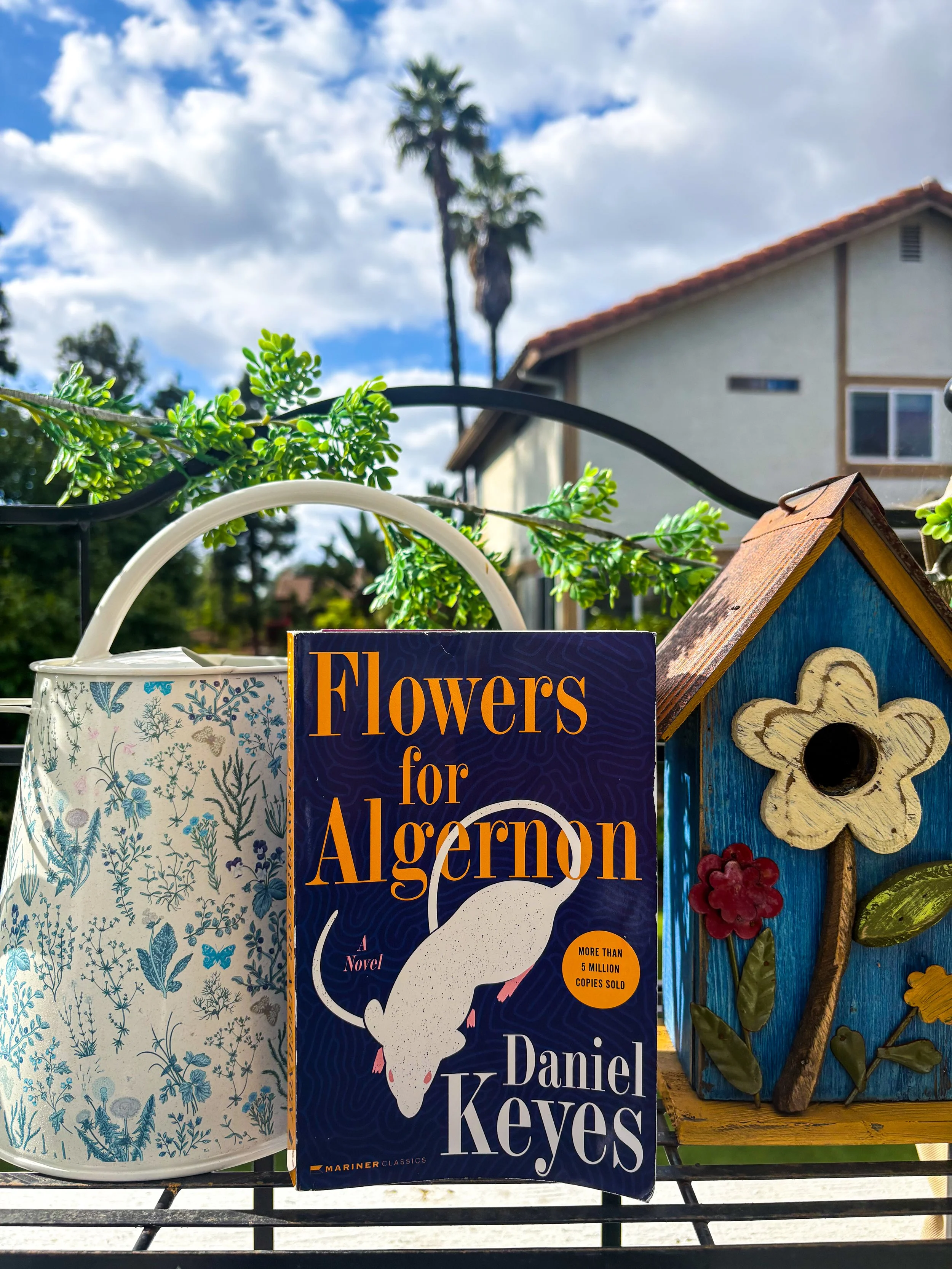
Flowers for Algernon by Daniel Keyes Book Review
I knew the ending before I even opened the book.
My husband, by accident, had helpfully informed me of the broad strokes before I got there myself: mentally disabled man receives experimental surgery, becomes a genius, loses it all.
That's the whole arc. I walked in with the ending already spoiled, already prepared, already thoroughly braced for impact.
Daniel Keyes still made me cry.
That is how powerful this book is. That is really the only thing you need to know about it. But since this is a review and not a bumper sticker, I'll keep going.
Charlie Gordon is thirty-two years old. He works as a janitor at Donner's Bakery in New York, earns eleven dollars a week, and attends Miss Kinnian's night class for retarded adults three times a week because he wants, more than anything in the world, to learn.
His IQ is 68. His spelling is atrocious. He signs his very first progress report "yrs truly Charlie Gordon" like he's writing a letter to a pen pal, because nobody told him he didn't have to.
Dr. Strauss and Professor Nemur have developed an experimental brain surgery to dramatically increase human intelligence. A lab mouse named Algernon has already had the procedure done successfully. Charlie is going to be the first human subject.
Charlie Gordon is one of those characters you fall in love with. He is genuinely kind, not performing kindness or strategic kindness, but the real unselfconscious kind that most people lose somewhere around age seven.
His motivations are so pure they're almost painful to look at directly. He doesn't want to be smart for power or status or revenge. He wants to be smart because he is lonely and he has somehow gotten it into his head that smart people have lots of friends and never have to sit by themselves.
The tragedy of what's coming is already coiled inside that belief before the surgery even happens.
I also have to be honest about something more personal, because I think it colored how I read this book. I have someone in my life like Charlie. Not exactly like him, but close enough that novels with mentally disabled characters always hit differently for me than they might for someone who doesn't.
I come in more protective of these characters, more alert to whether they're being written with genuine dignity or used as emotional props for the people around them.
Charlie Gordon has more dignity in his first progress report, misspellings and all, than most protagonists manage across an entire novel. Keyes never lets you forget that Charlie is a complete human being before the surgery, during it, and after it. He is not a before-and-after. He is not a case study, which is a running theme throughout the novel.
Nemur, who has been treating Charlie more or less like a particularly interesting lab rat from the jump, had mostly forgotten. Which is its own tragedy nested inside the larger one.
Now. Let me talk about what Keyes does technically, because I think it deserves more credit than it usually gets in casual conversation about this book.
Flowers for Algernon is an epistolary novel told entirely through Charlie's progress reports, which sounds like a straightforward enough device until you realize what Keyes is actually pulling off underneath it.
He uses the writing itself, the spelling and grammar and sentence structure and punctuation, as a direct real-time mirror of Charlie's mind. The early reports are phonetic and halting and achingly sincere. "
By the middle of the book the prose is fluid and sophisticated, running with an intellectual hunger that is genuinely impressive. Charlie is reading ancient languages. He is outpacing the scientists who created him. He is writing with the kind of precision and self-awareness that makes you forget, for stretches, who he used to be.
And then Algernon starts to deteriorate. The maze times slow. The behavior becomes erratic. And if you are paying attention, you start noticing something happening to Charlie's writing too. Errors creeping back in at the edges. Sentences losing their architecture. The mirror cracking in real time, right there on the page.
As an English teacher this device made me want to stand up and applaud. This is what form in service of content actually looks like. This is what it means for the how to be completely inseparable from the what. It is the kind of technical decision that sounds like a gimmick described out loud and is quietly devastating in practice, and Keyes executes it across the entire length of the novel without it ever feeling like a trick.
I was impressed.
The tension in this book builds and builds and builds. Because you know. Whether someone told you or you figured it out from the structure or you just felt it coming, you know Algernon is going to die, and you know what Algernon's death means for Charlie.
The mouse has always been the canary. So every single peak after a certain point becomes almost unbearable. Every breakthrough. Every moment where Charlie is brilliant and alive and operating at a level that would have been incomprehensible to the man at the beginning.
Every one of those moments is already shadowed. You're watching a countdown and you cannot stop it and neither can he. You just have to sit there and watch and wait and feel terrible about both.
Here is where I have to get honest about my criticisms though, because this review would be incomplete without them and I believe in transparency even when I really adore something.
The middle of this book drags. Not terribly, not fatally, but noticeably. There is a stretch in the middle where the momentum stalls and the plot loses some of its urgency, and I found myself pushing through rather than being pulled forward.
For a novel this emotionally precise in its best moments, those slower passages stand out more than they might in a lesser book.
My bigger issue, and I did not see this coming, is how sexual the novel gets. Charlie's awakening intelligence comes with a sexual awakening that Keyes spends a significant amount of time on, between his complicated feelings for his teacher Alice Kinnian and his more straightforwardly physical relationship with his neighbor Fay Lillman. And I just... found it odd.
Of all the human experiences Keyes could have chosen to explore as Charlie's emotional and social intelligence develops, the heavy focus on sexuality felt like a strange priority to me.
There are so many other dimensions of human experience, grief, friendship, creativity, belonging, that could have anchored that same developmental arc without making me feel like I was reading something that should not be assigned to read in middle school.
Which, speaking of: I was scandalized when I learned that middle schoolers read this book, and then deeply relieved when I learned that the version taught in schools is the original 1959 short story, not the full 1966 novel. The short story predates the more explicit content. Which is relieving to say the least.
My last criticism, and this one is complicated because I'm not sure it has a clean solution, is that Charlie's regression from genius back to his original self happens very abruptly.
One moment he is at the peak of his intelligence, having written his own scientific paper proving the flaw in Nemur's hypothesis (the Algernon-Gordon Effect, which is its own devastating detail), and then the decline happens so quickly that it almost outpaces the reader's ability to grieve it in real time.
I wanted more of that regression. I wanted to see more of it unfold, to watch it happen with the same aching slowness as the rise. And yet I also understand why Keyes made that choice, because elongating the regression would have elongated the pain past what any reader could reasonably bear, and the book is already operating at the very edge of tolerable sadness.
So I hold this criticism loosely. It's less a flaw than a heartbreaking structural decision that I respect even while wishing it had gone differently.
The ending is devastating.
Charlie's intelligence is gone. He can't be around anyone who remembers who he used to be, can't bear the pity of it, so he checks himself into the Warren State Home and writes one final progress report.
The grammar has collapsed back to what it was at the beginning. The spelling has returned. He's come full circle except he hasn't, not really, because somewhere underneath everything he's been and lost, there's just enough left to ask someone to leave flowers on a grave in the backyard.
This one got me. Decisively and without apology.
Recommendation: Read this book even if someone has already told you how it ends. Read it especially if someone has already told you how it ends, because knowing what's coming and being wrecked by it anyway is kind of the entire point, and also proof that Daniel Keyes was doing something extraordinary.
Score: 9/10


