Ender’s Game
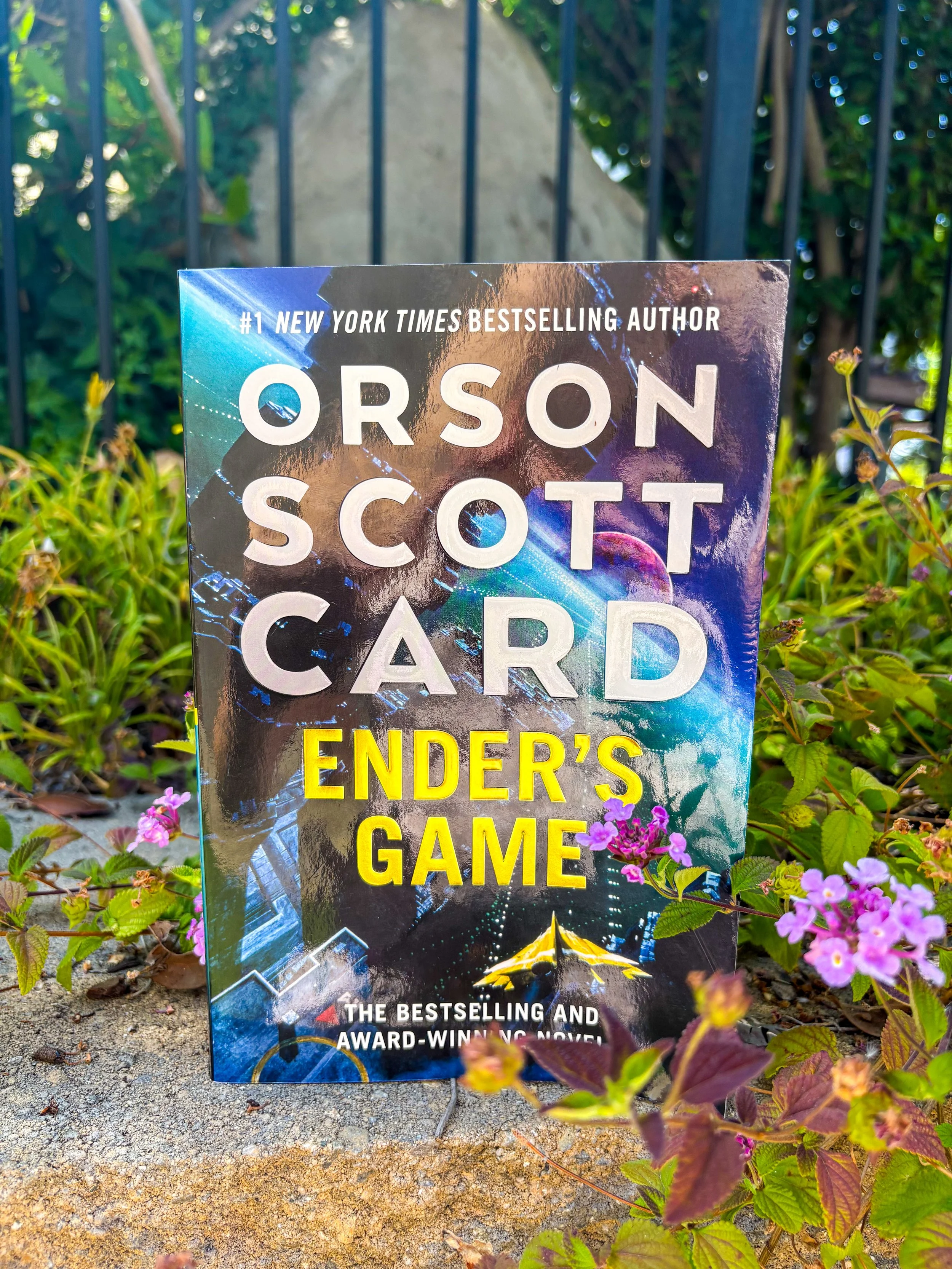
Spoilers for the book ahead
Ender’s Game by Orson Scott Card Book Review
I don't usually read science fiction. This is a well-established fact about me that I chose to ignore approximately two months ago when I finished Project Hail Mary and convinced myself, in a moment of post-book euphoria, that I had turned over a new leaf and become a different kind of reader.
I had not.
But the bandwagon was moving and everyone and their mother has apparently read and loved Ender's Game, and I had momentum, and so here we are.
I see why people love it. I do. I also think that if I had read it at twelve instead of thirty-two it might have been a formative experience instead of a very good book that punched me in the stomach repeatedly for three hundred pages and then sent me home.
Those are different things, and the gap between them is probably where most of my complicated feelings live.
Here's the plot, stripped to its bones: Andrew "Ender" Wiggin is a six year old genius (the third child in a future where the government controls family size so tightly that a third child requires special government permission, which is its own whole thing), selected by Colonel Hyrum Graff of the International Fleet to attend Battle School.
Earth has survived two devastating invasions from an insectoid alien race everyone calls the Buggers, and a third invasion is coming, and the International Fleet has decided that the person who is going to save humanity is a child.
Specifically this child.
So they take him away from his family, put him on a ship, and proceed to make his life as methodically miserable as possible in the name of making him the greatest military commander who has ever lived.
Battle School involves zero-gravity war games in a chamber called the Battle Room, competing armies of children with laser weapons, and a hierarchy so brutal it makes normal middle school look like a spa retreat (and I say that as someone who works in a high school).
Ender is extraordinary. Everyone knows he is extraordinary. This does not make anyone like him. It mostly makes people want to destroy him, which Graff has actually planned for, because apparently the philosophy of the International Fleet is that isolation and cruelty are the best ingredients for genius.
More on that in a moment.
First, the twist.
I am not going to tell you what it is. If you somehow don't know, protect that ignorance with everything you have and go in completely blind, because the twist at the end of Ender's Game is brilliant and accounts for at least half of this book's legendary reputation.
When it landed I sat with it. That doesn't happen often. Card earns it and it is satisfying in a way that recontextualizes everything you've read, which is exactly what a great twist is supposed to do.
I do want to say, though, that the road to that twist is longer and more repetitive than it needed to be. The book has a structural habit of building to what feels like a climax, a final test, the moment everything has been leading toward, and then pulling back and going: sike. Not yet.
Here's another layer. This happens enough times that by the third or fourth fake-out I started feeling less like a reader being skillfully guided through a story and more like someone being strung along at a carnival game, reaching for the prize only to watch it get moved back another foot. The twist is worth it when it finally arrives. The journey to it tries my patience more than once.
Now.
The child cruelty in this book is relentless and it bothered me significantly. Bonzo Madrid, the vindictive thirteen year old commander of Salamander Army who orders Ender to stand at the gate with his weapon holstered during every battle because he cannot stand the threat of being outshone by a ten year old, eventually escalates to cornering Ender alone in the shower room with a group of boys, intending to kill him.
Ender defends himself so efficiently and so brutally that Bonzo dies from his injuries afterward, which Ender doesn't find out until much later. Ender is ten. Bonzo is thirteen. This is a military training program for children.
I understand what Card is doing. I understand the argument that this is what happens when you strip children of childhood and treat war games as the only currency that matters, what the machine does to young minds when it grinds them through it.
It's a coherent and interesting argument. I just find it implausible that any government, even a fictional future one facing extinction, would run something this openly brutal on children this young and call it a training system (and I say this as someone who has read some things about how governments actually treat children in crisis situations, which, not great, but still).
At a certain point my suspension of disbelief quietly packed its bags.
The character work is what saves it, and I want to give Card his due here. Ender is an interesting protagonist, cold and precise and capable of a tactical cruelty he hates in himself and cannot stop.
His sister Valentine is the warmest thing in his world and gets used as a pawn against him by the adults in charge, which I found more upsetting than most of the Battle Room violence honestly.
His brother Peter is a full sociopath who bullies Ender with genuine menace and then whispers "I love you" to him in the dark when he thinks no one is watching, which is somehow the most unsettling detail in the whole book. Card is doing something real with these three as a unit and it works.
And the ending. Oof.
Without spoiling anything: after everything Ender goes through, everything done to him and in his name and through him without his knowledge or consent, Card does not let him have a single thing. Not peace. Not rest. Not even a version of happiness that feels remotely proportionate to what he survived.
I understand this is thematically consistent. I understand a tidy happy ending would undercut the argument the book spent three hundred pages making. I still finished the last page feeling like I had watched someone get hit by a car and then, while they were still lying in the road, watched another car hit them. Enough, Card. Let the child rest. He earned it.
Here is what I keep thinking about, though, and this is what I'll carry with me long after the frustrations fade. Ender's Game makes a fascinating companion piece to Project Hail Mary, which I read right before it. Both books are fundamentally about what humanity does when it encounters alien life it doesn't understand.
Project Hail Mary answers that question with radical optimism, Rocky, found family built on math and mutual desperation, and the most hopeful ending I've read in years.
Ender's Game answers it with annihilation.
Reading them back to back has been one of the more fascinating interesting literary experiences I've had recently, and I did not expect to get that out of a genre I don't even read.
Recommendation: The twist is worth it. Just calibrate your expectations knowing that this book is relentless in a way that doesn't really let up, that the fake-out endings will test you, and that Card is not interested in giving anyone, least of all Ender, a break.
Score: 7/10


