This Kingdom Will Not Kill Me
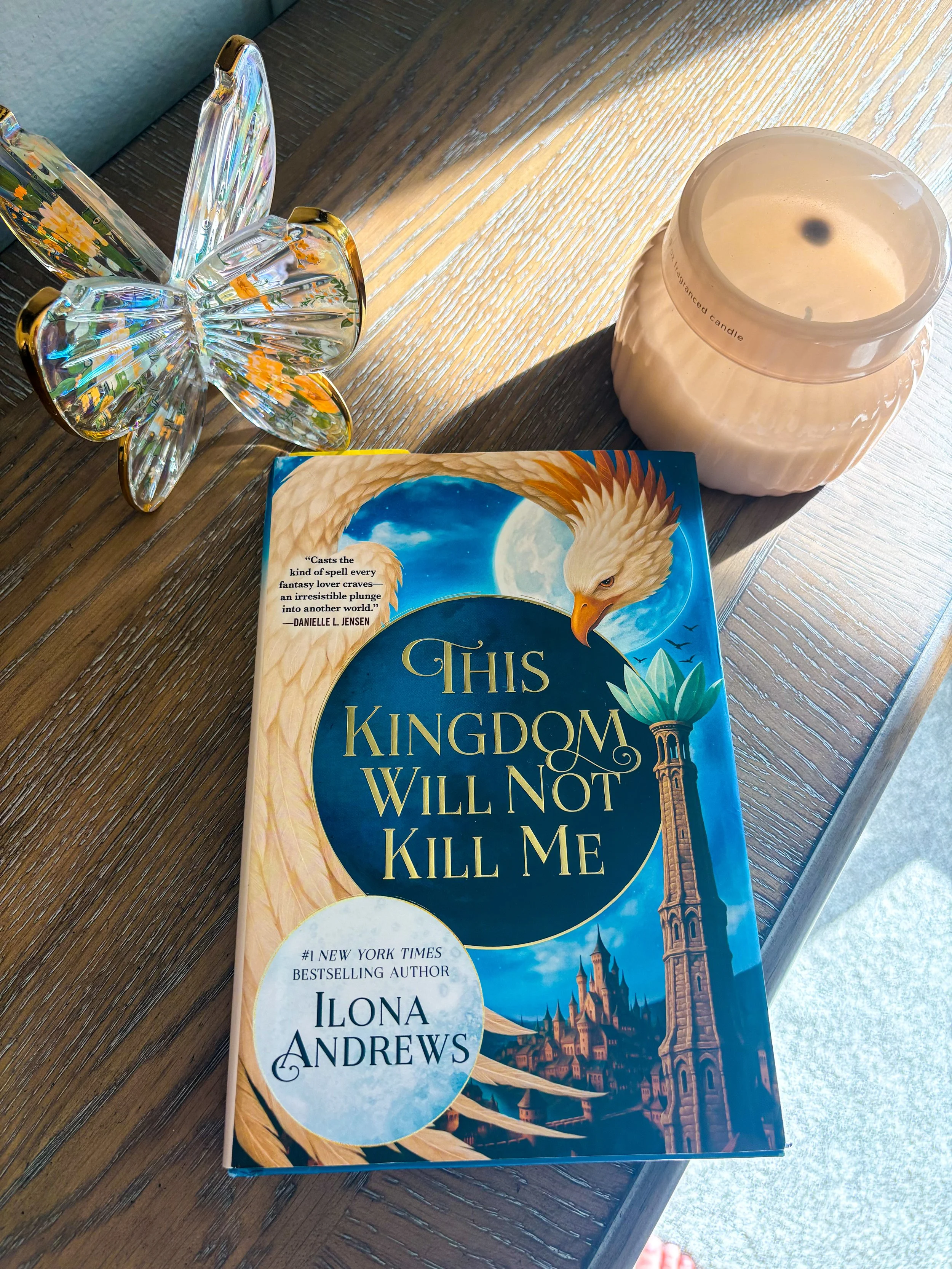
This Kingdom Will Not Kill Me by Ilona Andrews
*Warning for spoilers*
A woman wakes up cold, filthy, and naked in a gutter in the city of Kair Toren, a place she knows intimately, not because she's been there before, but because she has read and reread the dark fantasy series it belongs to approximately one million times while waiting for an author named Adrian Latour to get his act together and release the third book.
Her name is Maggie. She is twenty-six years old and works as a grocery delivery driver in Austin, Texas. She has a perfect recall of every political scheme, every bloodline, every character's fate in the entire series.
And the first thing that happens to her is that she starves in a ditch for three days and then gets stabbed to death.
When I picked up This Kingdom Will Not Kill Me, the title had me fully convinced I was walking into something fun. Something with a little wink to it (an isekai honestly), the kind of story that knows exactly how silly it is and leans into it with a smirk.
Maggie even says as much in the opening pages, listing all the isekai tropes she expected: the prophecy, the handsome prince pledging his sword to her, the army of maids, the convenient amnesia. A whole checklist of cozy portal fantasy beats she was absolutely prepared to enjoy.
None of that happens.
What she gets instead, what we get instead, is essentially Game of Thrones' younger cousin.
And honestly? Once I got over myself and recalibrated around page fifty, I was largely fine with that. "Surprised" and "disappointed" are not the same word, and I don't want to conflate them. But I do think it's worth naming upfront: if you pick this up because the title sounds fun and a little silly, prepare yourself.
This Kingdom Will Not Kill Me takes itself very seriously, goes to some genuinely dark places, and has approximately the same relationship to lighthearted fun as a medieval siege does.
That said—and I mean this—I had a genuinely good time.
Maggie is the best thing about this book and I want to say that right off the bat. The whole premise of her character is that she has knowledge but no power. She knows where the bodies are buried, who betrayed whom, what's coming, but she cannot simply show up and announce "hello I am a prophet" and have anyone believe her.
She has to earn her place in Kair Toren through sheer intelligence and careful maneuvering. And what impressed me most is that Andrews trusts that intelligence completely. Maggie doesn't use her foreknowledge as a crutch.
She doesn't let it make her stupid or reckless. When she engineers her "chance meeting" with the blademaster Reynald Karis by feeding him just enough information about his past to make him believe she has prophetic magic, that's not luck, that's a woman thinking three moves ahead and executing perfectly.
I also want to talk about the found family because I was genuinely pretty impressed and surprised by it in this book. Clover, the former lady's maid who comes with a backstory that I will not spoil but which made me want to commit several crimes on her behalf, is a delight—fierce and loyal and competent in a way that feels earned rather than convenient.
Kaiden, the twelve-year-old boy they rescue from Derog's operation, is an adorable little menace who worships Reynald and absolutely tattles on Maggie at every available opportunity. The Magnar mercenary family rounds out the household.
Watching all of these people, none of whom were supposed to matter to the story, all of whom the original books would have discarded as minor characters, coalesce into something that actually resembles a family is quietly one of the best things Andrews does here.
Nobody exists purely as a plot function. Everyone has a life that exists around the edges of their role, and that is genuinely hard to pull off in a book that also has this much political machinery running simultaneously.
The action sequences are written cleanly and confidently. The fight choreography is clear. You always know what's happening and why it matters, which sounds like a low bar until you've read enough fantasy to understand it really, truly is not.
Now.
The torturer scene.
I want to acknowledge it exists because I think going in blind is a disservice to the reader. The Dog Market Butcher, a serial killer Maggie knows from the books, intercepts her, and what follows is graphic in a way that I was not prepared for and that the cheerful title does absolutely nothing to warn you about.
Maggie resurrects. She kills him. The story moves on. But I'm not sure I moved on quite as quickly as the narrative seemed to expect me to, and I think that's worth saying.
Here is where I get complicated, because my biggest frustration with this book is the world itself, or more specifically, the way we're asked to absorb it.
By the way, Ilona Andrews is a pen name for a husband and wife writing team, which I find genuinely delightful and cannot stop thinking about.These two have clearly built an extraordinarily detailed world: The Eight Great Families. The Savarics, the Hrebans, the Everards, the Yolentas, the Arvels, the Bors, the Berengurs.
The political web connecting all of them. The hereditary magic systems. The history of King Sauven Savaric's paranoid, increasingly unhinged reign. The color-coded crests and caste structures and centuries of betrayal layered underneath everything.
You can feel the effort. Someone—or rather two someones—cared enormously about making this world feel real and lived-in and historically coherent.
The problem is that Maggie will not stop telling you about all of it.
The tangents. There are so many tangents. Maggie will be mid-scene, something is actively happening, and then she'll spiral off into a history lesson about the Hreban family's relationship to gold, or the political circumstances that gave Ulmar Hreban his military foothold a decade before the events of the book, and I just...
I stopped caring. Somewhere around the fourth extended detour into a family dynamic I was never going to fully track, I started nodding along the way you do when someone at a party is explaining a very complicated drama involving people you will never meet and you gave up asking clarifying questions ten minutes ago and are now just waiting for them to finish.
There are so many names in this book. So many S names in particular: Sauven, Savaric, Solentine, Silveren, etc. They all blurred together into one impressive-sounding muddle no matter how many times they appeared. The frustrating part is that the bones of this world are genuinely interesting.
There's something compelling underneath all of it. But the sheer volume of information keeps interrupting the story to prove how much thought went into it, and those are two very different things.
There is a difference between a world that feels real and a world that is trying very hard to convince you it's real. The first pulls you in. The second keeps tapping you on the shoulder. Andrews tips into the second more often than the book can afford, and it costs the story more than it should, especially because everything else is working so well.
Tighten the tangents. Trust the reader. The world is already there.
All of that said, this was a confident, propulsive fantasy with a heroine worth following, a found family that gave me actual feelings, action that delivers, and a slow burn romance that I can see going somewhere genuinely interesting.
The darkness was more than I personally signed up for based on the title's energy, and the worldbuilding needs a firm editorial hand. But I don't regret a single page of it (except for that aforementioned Butcher scene).
Recommendation: Go in knowing this is dense, serious, Game of Thrones-adjacent grimdark fantasy rather than the breezy portal fun the title implies, and you will have a significantly better time than I did in those first fifty pages of recalibration. Maggie is worth it. Just accept that some of those family names are never going to fully stick and make peace with that now rather than later.
Score: 7/10


