The Road to Tender Hearts
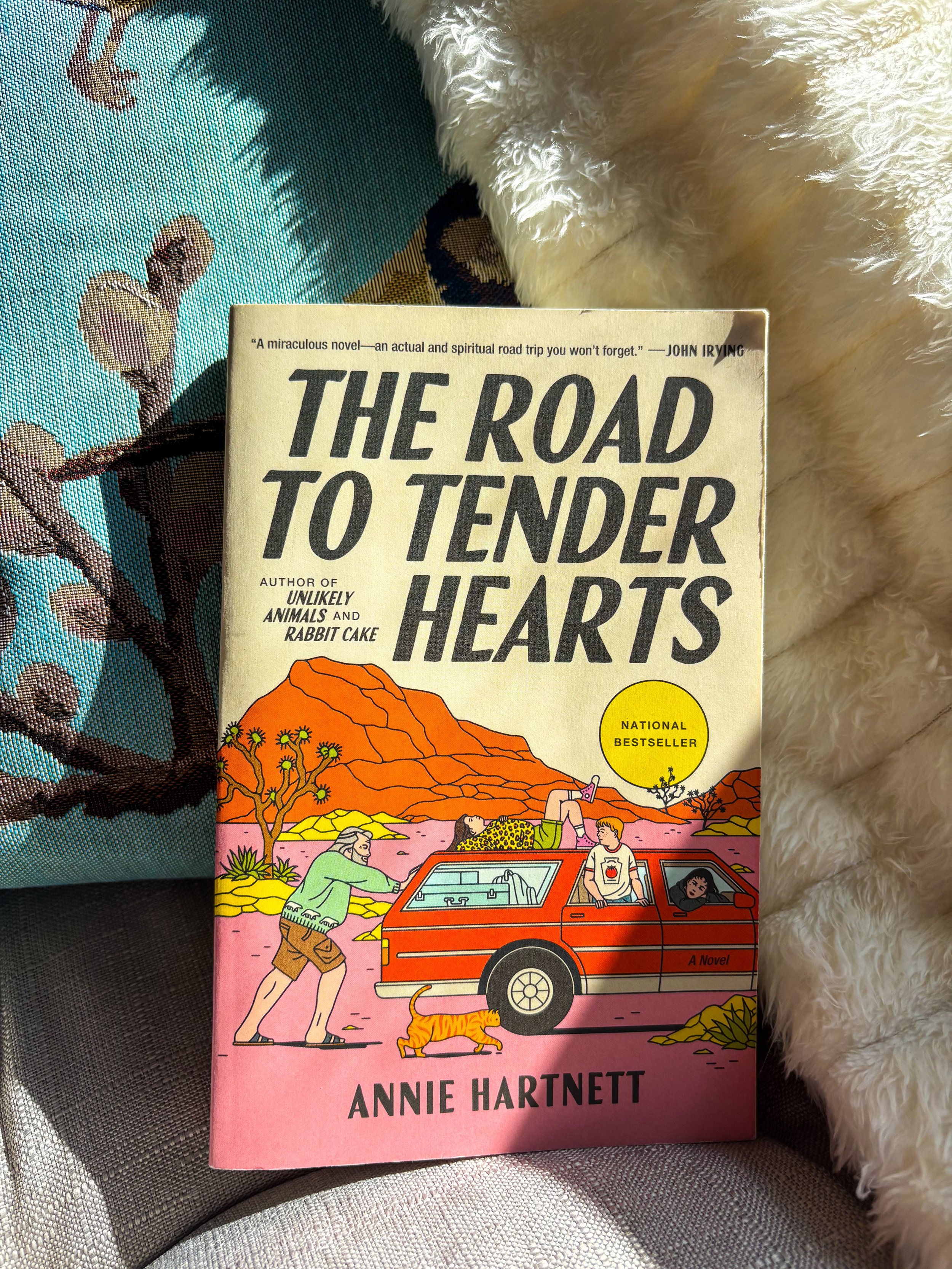
The Road to Tender Hearts by Annie Hartnett Book Review
Spoilers for the book ahead
I have a complicated relationship with author's notes.
Normally I skim them out of a vague sense of obligation and then immediately forget they existed. But Annie Hartnett's note at the end of The Road to Tender Hearts stopped me for a moment, and I think it's the key to understanding what this book actually is underneath all its considerable charm.
Hartnett writes that she came to this story as a mother of a five year old, that it is essentially all of her worst fears made literary, the realization that as a parent, danger lurks everywhere no matter how carefully you try to keep your child safe from it.
Once you know that, you feel it on every page. The book reads differently. The darkness, which is significant and sometimes genuinely harrowing, stops feeling like a quirky contrast to the comedy and starts feeling like the whole point.
So. What is the book, exactly.
PJ Halliday is sixty-three years old, a lottery winner (1.5 million dollars, which sounds like a lot until you watch him spend it on bar tabs and iPads for children he just met), a three-time heart attack survivor, an alcoholic, and one of the more endearingly catastrophic protagonists to come across.
He lives in Pondville, Massachusetts (a setting I can envision quite well as my Grandma lives in MA), two blocks away from his ex-wife Ivy and her boyfriend Fred (who is also PJ's best friend, because PJ's life is exactly that kind of situation).
Ivy cuts bad news about children and animals out of the newspaper before PJ reads it every morning because he cannot handle it. This is the level of active management required to keep PJ Halliday functional on a daily basis.
When PJ reads an obituary and realizes his high school sweetheart Michelle Cobb is newly widowed, he decides to steal Fred's Volvo and drive cross-country to the Tender Hearts Retirement Community in Arizona to propose to her.
His license is suspended from drunk driving. He has had three heart attacks. He goes anyway, because he is PJ. Before he can even get out the door, two orphaned children named Luna (ten) and Ollie (nine) arrive on his doorstep, the result of a murder-suicide two blocks away, because this book is cozy and simultaneously extremely dark and it holds both of those things at the same time without flinching.
PJ, being PJ, figures he'll bring them along. Sophie, his twenty-six year old daughter who is unemployed and barely tolerating her father's existence, gets roped in as a babysitter.
And Pancakes, a former nursing home therapy cat with the documented ability to predict death, has adopted PJ and is absolutely not being left behind.
This is the group. This is the road trip.
I loved Hartnett's previous novel Unlikely Animals, so I want to be transparent that I came into this one with expectations already calibrated to her specific brand of small-town magical realism, which is: laugh-out-loud funny, shockingly dark, and populated by characters who are flawed in ways that feel human rather than plopped in.
The Road to Tender Hearts delivers all of that. It also, in my opinion, doesn't quite hit the same heights, and I think that's worth saying even though I really did enjoy it.
The characters are wonderful. PJ in his polar bear sweater and Birkenstocks, generous and flatulent and genuinely trying to be better, is deeply lovable in a way that sneaks up on you.
Sophie's complicated love for her father, defensive and frustrated on the surface and fiercely protective underneath, is written with the kind of accuracy that makes you feel seen even when it's not your story.
And Pancakes, who knows who is going to die before they do and goes to sit with them so their last moments include a purring cat, is both funny and moving in complicated ways.
Hartnett also does the thing I love most about her writing, which is giving us perspectives we have no business caring about and making us care about them enormously anyway. In Unlikely Animals it was the ghosts of the town cemetery.
Here we get Pancakes' internal monologue, a pair of vultures chanting "alive, alive, alive" over the children, an alligator named T. Boone Pickens, and various other creature POVs scattered throughout.
It should feel like a gimmick. It never does. Every single one of those moments adds something that the human characters couldn't have given us, and Hartnett knows exactly when to deploy them.
Here is where I have to be honest, though.
The Road to Tender Hearts is darker and measurably less funny than Unlikely Animals, and I think that shift in balance costs the book something.
In Unlikely Animals I was laughing out loud regularly despite (or maybe because of) how much grief was on the page. The humor here is real and it lands, but it's working harder against heavier material, and occasionally the lightness doesn't quite win.
The Starling family in Unlikely Animals had a resilience to them, a stubborn aliveness, that made me root for them without ever feeling sorry for them. PJ and his crew tip more toward pity sometimes than I wanted, and I noticed the difference.
My bigger frustration is the loose threads. Unlikely Animals is almost too neatly resolved, all the pieces clicking into place at the end in a way that was deeply satisfying even if it occasionally felt slightly engineered. I actually prefer that to what Road to Tender Hearts does, which is introduce threads that don't quite land anywhere.
Luna's obsession with finding her supposed biological father, the soap opera star Mark Stackpole, drives a significant portion of the road trip and resolves in a way that felt underbaked relative to how much space it had been given.
The Michelle Cobb storyline, which is ostensibly the entire reason any of this is happening, resolves in a genuinely surprising twist that I won't spoil but that I wanted more aftermath from. Things happen and the book moves on, and I kept wanting it to slow down and sit in what it had just done.
None of that is enough to significantly dent my enjoyment, however. This book is warm and funny and endearing in the way only Hartnett seems to be able to manage, which is making death feel like a presence without making the story feel like it's about death.
She lays it out, acknowledged and real, while the living keep being funny and messy and stubbornly human around it. Pancakes keeps predicting. The vultures keep circling. PJ keeps trying. And somehow, despite everything, the book earns its title.
Recommendation: If you loved Unlikely Animals, read this one, just manage your expectations that it's a slightly darker, slightly less tightly funnier version of the same magic.
Score: 7/10


