Blood Over Bright Haven
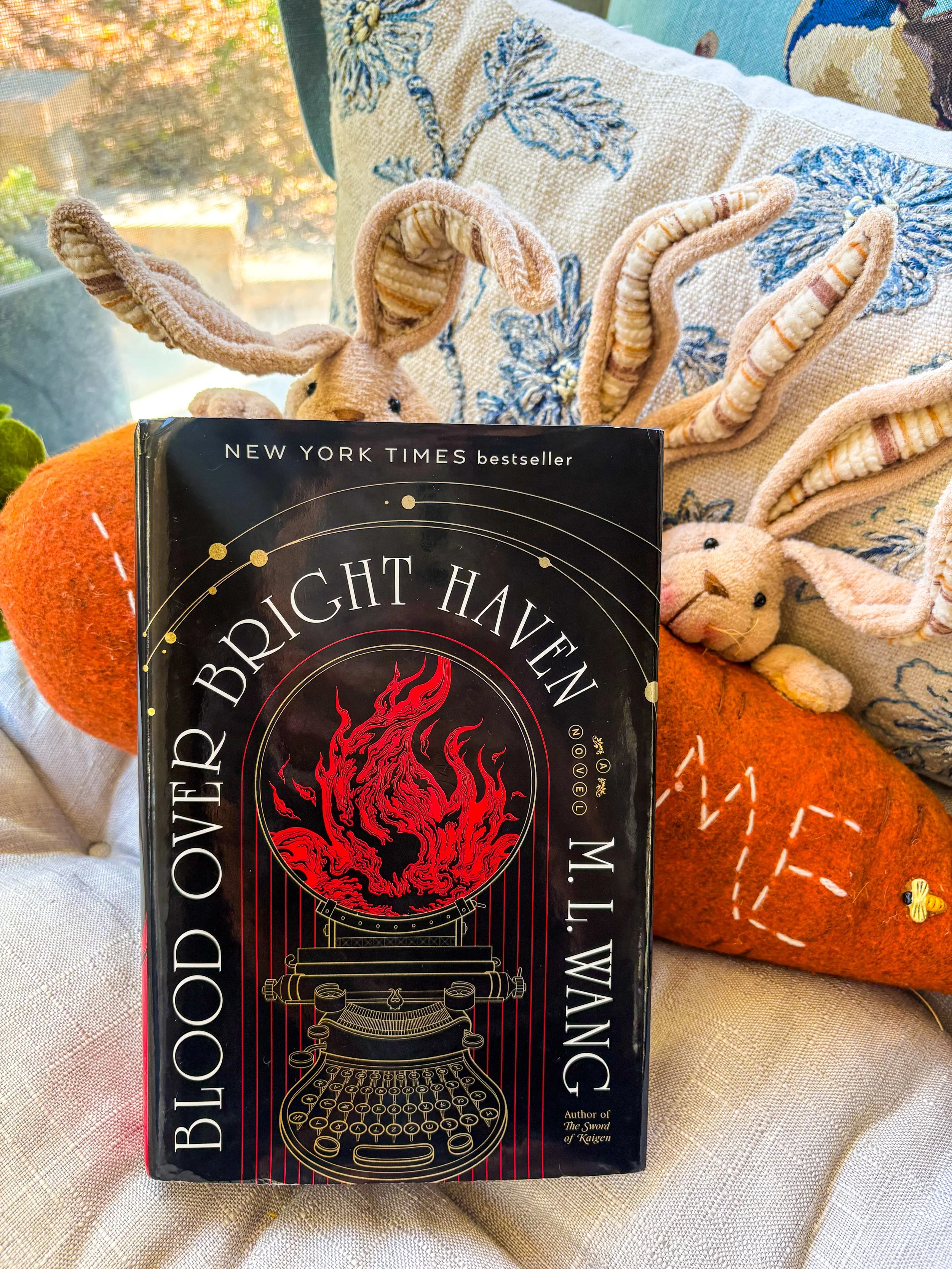
Blood Over Bright Haven Book Review by M.L. Wang
Spoilers for the entire novel ahead. Read with caution
This book was recommended to me by both a librarian and a good friend, and yet, my expectations were still low. I'm not sure why I went in thinking it wouldn't be fantastic, maybe I wasn't too sold on the premise—mages, blights, an enclosed city—it just felt like I had read all these stories before.
However, I had gotten to the end of my TBR list and here we are. In a rare turn of events, I was both right and wrong in regards to Blood Over Bright Haven.
Three-fourths of the book was exactly as I expected: cliched, pedantic, boring, tedious, and somehow slow with nothing much happening while still being fast-paced. But then, the last fourth of the book blew my mind. It came out of left field and resulted in winding me right at the end, like a sucker punch to the gut.
You might wonder—how does that affect the score then? If most of the book was a drag and then the end was a brilliant star—how do you rate that? That's what I'm attempting to do in this book review as even I'm not sure where I fall on the rating of this book.
I guess we'll start at the beginning.
Sciona Freynan is our main character, a brilliant female mage living in the world of Tiran, a magically barricaded city run by otherworldly energy that is siphoned and controlled by the mages of the city, many or all of whom run the government (I think???).
Outside of Tiran, the blight rages on indiscriminately, an electric white light that unravels all living things and only leaves behind entrails and blood. Outside of Tiran lives the Kwen–people who have been forced to migrate and hunt for new sources of food and livelihood as the blight devours more and more of life outside of Tiran.
Things become so dire for different Kwen tribes that they are forced to cross into Tiran where they are treated like slaves with no rights and seen as uncivilized people not worthy of basic human dignity or rights.
On top of this, Tiran is a very devout society where the religious texts have formed the basis of all Tiranish government and ways of life: including treating the Kwen as inferior and thinking of all women as submissive, unintelligent, and weak.
Despite this, Sciona wants to become the first female High Mage, join the High Council, and make her unwomanly mark on the world like the other men from history.
She plans to do this alone, but she ends up with a Kwen assistant—Thomil—who ends up changing her life in more ways than one when she realizes that the blight isn't an accident, but intentional, and that her heroes are the monsters wielding it.
Sciona has a painful reckoning when she comes face-to-face with the truth of the blight: it is the life force taken from living things and used by mages for energy to run their all-powerful city of Tiran.
Sciona at first refuses the truth and denies that the government is aware of this. Spoiler alert: they all know about it and they don't give a single shit.
Sciona, Thomil, and Carra (Thomil's niece/daughter) then concoct a plan to expose the truth to the citizens of Tiran in an attempt to start changing things for the better and eradicating the blight.
I could go more into the details and nitty gritty of the story, but that's essentially the first three-fourths of the book. Not much action or choice drives the plot.
It's just scene after scene of explaining the world and showing Tiran, Sciona learning the truth, denying the truth, finally accepting the truth, and then deciding to do something to change it.
Mainly this time was used by M.L. Wang to elucidate in excruciating detail her world, the religion behind it, the history that it was founded upon, and how the magic works.
I have to admit, I didn't care about any of it.
World building and exposition is a delicate balance and while M.L. Wang sometimes did it well, more often than not it would be pages and pages of Sciona explaining some very technical way that she uses coils and spellographs and coordinates to write a spell and…I got so bored and tired.
I appreciate Wang putting the time and energy into making laws and rules for her world but she spends so much time doing this that it actively takes away from the novel.
It was too much and honestly? It didn't matter. It's magic. I get it. Explain the coordinates and the other otherrealm and the spellographs once and leave it alone. It needs a page. Max.
The religious background and texts I'm more torn about because while it was also boring it was more plot relevant as a whole to understanding the people of Tiran and their philosophy.
That being said, I still think she could have cut down on it. There are so many saints and founding fathers and important people that it all started to blend together for me in a meaningless dump of information. Again, I appreciate the effort, but it needed to be sheared for the sake of the story.
All of this is strike one and knocks the score of the book down considerably.
Next, in connection to the religious backdrop, Tiran is the worst city in the world.
I understand that Wang wanted it to be representative of today's world with racism, classism, sexism, etc, but the city of Tiran is so extreme. All of the characters are so so extreme. If you're not sure what I mean, let me explain.
It's not enough that Sciona is literally the first female mage in history, but all of her male coworkers treat her like shit. Literally all of them. There is not a single redeeming man in this whole story other than Thomil, her Kwen assistant.
Every other man is not only the most sexist, but also the most cruel, condescending, controlling, selfish person alive. They are all murderers, rapists, and criminals.
Even her mentor, the one man she believes is doing good and cares for her, is secretly employing factories of Kwen women with unsafe conditions that is knowingly resulting in mass sterilization. Which is insane.
Where is the nuance? Where is the subtlety? I am so sick of books making such black and white parameters for their world. It's ludicrous to me, but not only that but it's boring. Casting an entire gender as evil incarnate is incredibly dull and unoriginal.
In addition to this, Sciona is the worst. I actually ended up liking her character by the end, but her whole growth arc is that she doesn't care about others or pay attention to them because she's so smart and better and not like other girls.
She's going to be a smart mage. She doesn't want to be a mother, or a wife. Bleh! She doesn't care about romance or how she dresses—only the pursuit of truth and knowledge matters!
I like Sciona's selfishness and monstrous drive for knowledge and truth, but why does that have to be mutually exclusive with other typically "feminine" things? Why can't she still pursue those goals, but still care about how she appears? Or maybe she still wants romance in her life or eventually to be a mom.
I feel like this archetype is incredibly common in both YA literature and Adult Fantasy at the moment and it pisses me off. I don't feel like it's representative of women at all.
It's okay to want to be a mom. That doesn't make you weak. It's okay to care about your appearance, it doesn't make you petty or vapid. These women like Sciona are trying to prove themselves as women by both disregarding and rejecting typically feminine roles. How is that empowering? How is that proving your point?
The lines that Sciona draws (and therefore Wang) are so closed-minded that I think it comes full circle to being more repressive to women. Why are these characters forced into such strict parameters?
It's okay to have nuance. It would have been sooooo much more intriguing if Sciona was obsessed with truth and knowledge, but also wanted a boyfriend. Or also knew that she wanted to have kids one day.
Now, I'm not saying all women must want to have kids. That's not my point. People have every right to make that choice for themselves.
What I'm saying is that I'm tired of seeing these female characters that I think are supposed to be depicted as "strong" and "different" and an embodiment of women, women's strength, and female resilience, but are actually just negating and actively critiquing typically feminine attributes which…seems to be antithetical to the whole message to me???
I'm curious if anyone else feels this way or it's just me. Please let me know in a comment if that's the case.
Lastly, because I know I've gone on and on about Sciona, but her whole growth is that she didn't care about others and now she does. And yet, her whole goal at the beginning is to be a High Mage so that she can help others.
Which one is it? Is Sciona selfish and focused or is she empathetic and servicing others? Both Sciona and Wang seemed to be confused about this point and therefore, so was I as a reader.
Now, up to this point of the book, I would have rated it a 4. Sciona sucked, the setting sucked, the writing was technical and boring, and the plot was meh.
Then, it's like a switch flipped. Sciona decides she's going to create magical portals all over the city showing the Tiranish citizens that the magic that runs their train, their lightbulbs, their hot water—is all taken from life—plants, animals, and people, the Kwen specifically.
These portals unleash a domino effect that results in the city revolting, the Kwen revolting, and Sciona hatching a plan where all 300 government officials are attending her heavily guarded and secure death row trial where she instead makes some kind of spell that siphons all the energy from all life inside the building—including her.
It's literally mass murder and it's crazy. I loved it.
You get Sciona's POV as she's dying and I kept expecting Wang to save her, for her to somehow survive and yet…she doesn't.
She dies. Thinking of her family and friends at the end, Sciona leaves this world a monster with all the other men she looked up to.
It was a brilliant, poignant, powerful ending. I haven't read about many main characters dying, and you especially don't usually get their POV while it's happening. I was shocked and impressed.
Unfortunately, I think the book should have ended there. If it had ended on that climactic moment, this book would have gotten an 8/10 for me for such a bombastic, unexpected, ballsy ending, not to mention the critically significant moment just earlier where she has her confrontation with Archmage Bringham, her mentor. Usually authors chicken out or don't write intense confrontations very well and Wang delivered here very well!
However, the book then loses steam, pace, and momentum when there's still 20-30 pages left after Sciona dies detailing Thomil and Carra leaving the city, the confrontation with guards and police, and the eventual returning of home. This should have been a one-page epilogue instead of the thirty-page continuation we got.
It was too long of a section after such a high previously and all of it could have been inferred. End it on a high note, including a one-page epilogue of Thomil being back home outside the walls and bam! An easy 8/10.
However, Wang went back to her old style of writing after the banger ending chapters and it left a disappointingly sour taste in my mouth.
All that being said, after putting everything together, I'm giving this book a 6.5/10. The ending was so strong and compelling, but it wasn't enough to pull the beginning pages out of the dregs of despair.
Recommendation: I think I've said it all.
Score: 6.5/10


