The Knight and the Moth
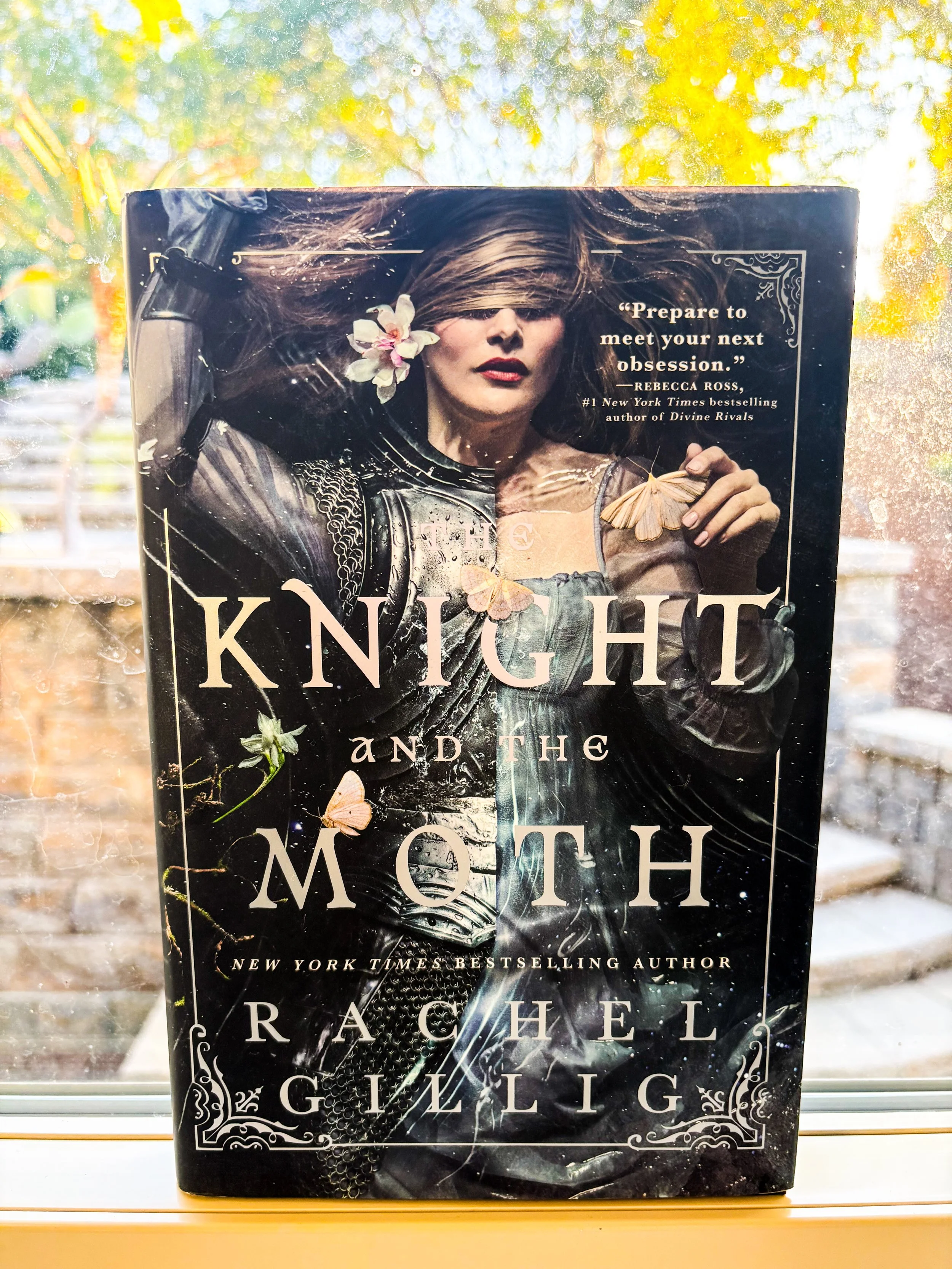
The Knight and the Moth Book Review by Rachel Gillig
**Spoilers for the whole book*
This book was recommended to me by my librarian friend, a friend whose opinion I deeply trust. For the first 2/3rds of the book it was so close to being something I'd recommend without hesitation.
So. Close.
The Knight and the Moth by Rachel Gillig is a gothic romantasy that had me genuinely hooked for most of it before it stumbled at the finish line and face-planted into predictability.
The story follows Sybil Delling—though she's known only as "Six" for most of the book—one of six foundling girls raised in the imposing Aisling Cathedral.
These girls, the Diviners, have one job: drown in a sacred (read: disgusting, oily, rotten-flower-smelling) spring to receive visions from the six divine Omens who supposedly rule the Kingdom of Traum.
It's as horrifically intriguing as it sounds.
The Diviners are kept shrouded, nameless, and isolated for ten years of service. They drink the blood of supplicants seeking their fortunes, then get dunked in the magic drowning pool where they dream of ominous prophecies.
It's gothic, it's atmospheric, and honestly? The opening chapters are chef's kiss.
Enter King Benedict Castor III—Benji to his friends—a seventeen-year-old boy king who arrives at the cathedral for his divination. Six draws the short straw (literally) and drowns for him, seeing five catastrophically bad omens involving a coin, an inkwell, an oar, a chime, and a loom stone. There's also a mysterious sixth Omen: a moth.
Shortly after, Six's fellow Diviners start vanishing one by one. With her ten years of service almost up and freedom tantalizingly close, Six decides she's not waiting around to disappear next.
She breaks every rule and joins the king's quest to figure out what's happening to her sisters (quiet easily actually which adds to the surreality of it).
This is where we meet Rodrick "Rory" Myndacious (a dumb name imo), the heretical knight with smudged eyeliner (yes, really) and zero respect for Six's visions. He's rude, brooding, and—you guessed it—devilishly handsome. Classic enemies-to-lovers setup.
Rounding out the crew is Maude, a forty-one-year-old veteran knight who becomes the motherly figure Six desperately needed, and Bartholomew, a talking limestone gargoyle who calls literally everyone "Bartholomew" and steals every scene he's in. (Honestly, this gargoyle is the MVP of the entire book and I will hear no arguments.)
The quest takes them through the five hamlets of Traum, each dedicated to one of the Omens, as Benji attempts to collect the magical objects tied to each god. Along the way, Six learns that literally everything she believed is a lie.
The Omens aren't divine beings—they're mortals who drank from the spring and gained power through their magical stone objects. The vanished Diviners? Sacrificed to feed these false gods and keep them alive.
Oh, and the Abbess—the woman who raised Six and the other girls—turns out to be the Moth, the sixth and final Omen.
Shocking, right? (It's not.)
The gothic atmosphere of Aisling Cathedral is exquisite. Gillig knows how to craft a setting that feels both beautiful and deeply unsettling.
The image of six shrouded girls drowning for prophecy in a crumbling cathedral on a windswept tor? Perfection.
But here's the problem: the world building felt incomplete. We get hints of this fascinating magic system—the spring, the Omens, the stone objects that can teleport people and destroy enemies—but it's never fully fleshed out.
I kept waiting for deeper explanations about how any of this actually works, and instead got a road trip through tiny hamlets that all felt a bit samey.
The kingdom of Traum consists of five hamlets. That's it. Five. The whole quest structure turned the middle of the book into a bit of a slog as they visited each hamlet, performed some ritual, fought some sprites (tree sprites, water sprites, mountain sprites—take your pick), and moved on to the next one.
It was fine, but it wasn't the most fleshed out or gripping setting I’ve ever read about.
In terms of characters, I liked them, I genuinely did, but none of them stood out to me either. Six/Sybil is a decently compelling protagonist struggling with her identity after years of being stripped of her name and autonomy.
Watching her reclaim herself was satisfying when the book let her actually do things instead of just being told what to do.
Maude was a breath of fresh air—a middle-aged woman knight who kicks ass and provides emotional support without being reduced to just "the mom friend."
Bartholomew the gargoyle is pure chaos and I would die for him.
Rory? He had potential. The heretical knight who doesn't believe in the Diviners' visions, who challenges Six's worldview, who has mysterious connections to the Artful Brigand's coin? There was genuine chemistry there when the book gave them room to actually develop their relationship.
Which brings me to my biggest issue with the romance: The Enemies-to-Lovers Trainwreck.
Look, I love a good enemies-to-lovers arc. Give me the slow burn, the gradual realization, the "oh no, I actually care about this infuriating person" moment that sneaks up on both characters.
This was not that.
Six and Rory go from actively disliking each other to making meaningful eye contact to confessing feelings in what feels like five chapters.
There's no gradual thawing. There's no slow building of trust. One minute she's irritated by his skepticism, the next she's removing her shroud for him and they're having sex.
Where was the development? Where was the yearning?
The book kept telling me about their connection instead of showing me why it mattered. I needed more scenes of them talking, arguing, finding common ground, slowly letting their guards down.
Instead, it felt like the author was speed-running through the romance beats because the plot demanded they be in love by a certain point in the story.
They fell too hard, too fast, without earning any of those emotional moments, which is maybe more of an issue with the pacing than anything else.
The first third? Fantastic. Atmospheric, mysterious, compelling.
The middle third? Serviceable quest narrative that dragged a bit but kept me reading.
The final third? Oof.
Here's where everything fell apart for me: King Benedict becomes the villain.
And not even an interesting villain.
Benji, the boy king who seemed poised to be a complex character grappling with the weight of his crown and the heretical knowledge his grandfather left behind, just... turns evil.
He betrays Six, Rory, Maude, and even Bartholomew. He wants to take the Omens' power for himself and force Six to be his queen so she can legitimize his rule with her connection to Aisling Cathedral.
It was predictable as hell. I saw it coming from miles away, which made it even more disappointing when it actually happened.
But worse than being predictable? It was boring. I hate the direction the book is going in. Six being forced into a wife? Lame and strange and nonsensical.
Why make Benji a villain with zero redeeming qualities? Where was the nuance? Where were the difficult choices that would make you understand—even if you didn't agree with—why he went down this path?
He's seventeen years old, thrust into kingship after his grandfather was stoned to death for heresy, desperate to hold onto power in a kingdom built on lies.
That's compelling! That could have been so interesting!
Instead, he just becomes a generic power-hungry antagonist who threatens everyone Six cares about and forces her to go with him to save them.
There's no moral complexity, no tragic fall from grace, no sense that this was a character making terrible choices for understandable reasons.
He just... sucks by the end.
Compare that to the Abbess being revealed as the Moth. Was it predictable? Yes. But at least her motivations made sense! She created the entire system of Omens and Diviners to maintain power.
Her actions throughout the book clicked into place when you looked back. She had layers, even as a villain.
Benji got flattened into a cardboard cutout of an antagonist, and it cheapened the entire ending.
The book ends on a cliffhanger with Six being positioned as a new "god" for the kingdom, Benji threatening everyone she loves, and her forced to comply to save them. It felt manipulative—like Gillig needed a dramatic hook for book two but didn't earn it through the story she was telling.
I didn't hate this book. There were genuinely good moments. The opening was gripping, Bartholomew is a treasure, the gothic atmosphere is top-notch, and the found family dynamics between the Diviners were decent.
But the rushed romance, incomplete world building, and disappointing villain arc seriously weakened what could have been a great fantasy novel. I wanted to love this so much more than I did, and I'm frustrated by all the missed potential.
The Knight and the Moth isn't a bad book—it's a frustrating one. It has all the pieces for something spectacular and then doesn't quite stick the landing.
Recommendation: If you're looking for a gothic romantasy with atmospheric writing and you can forgive rushed character development and predictable plot twists, you might enjoy this.
If you need slow-burn romance that's actually slow, complex villains with real motivations, and fully realized world building, you'll probably end up as disappointed as I was. Read it for Bartholomew the gargoyle if nothing else—he deserves all the love.
Score: 6/10


