Yesteryear
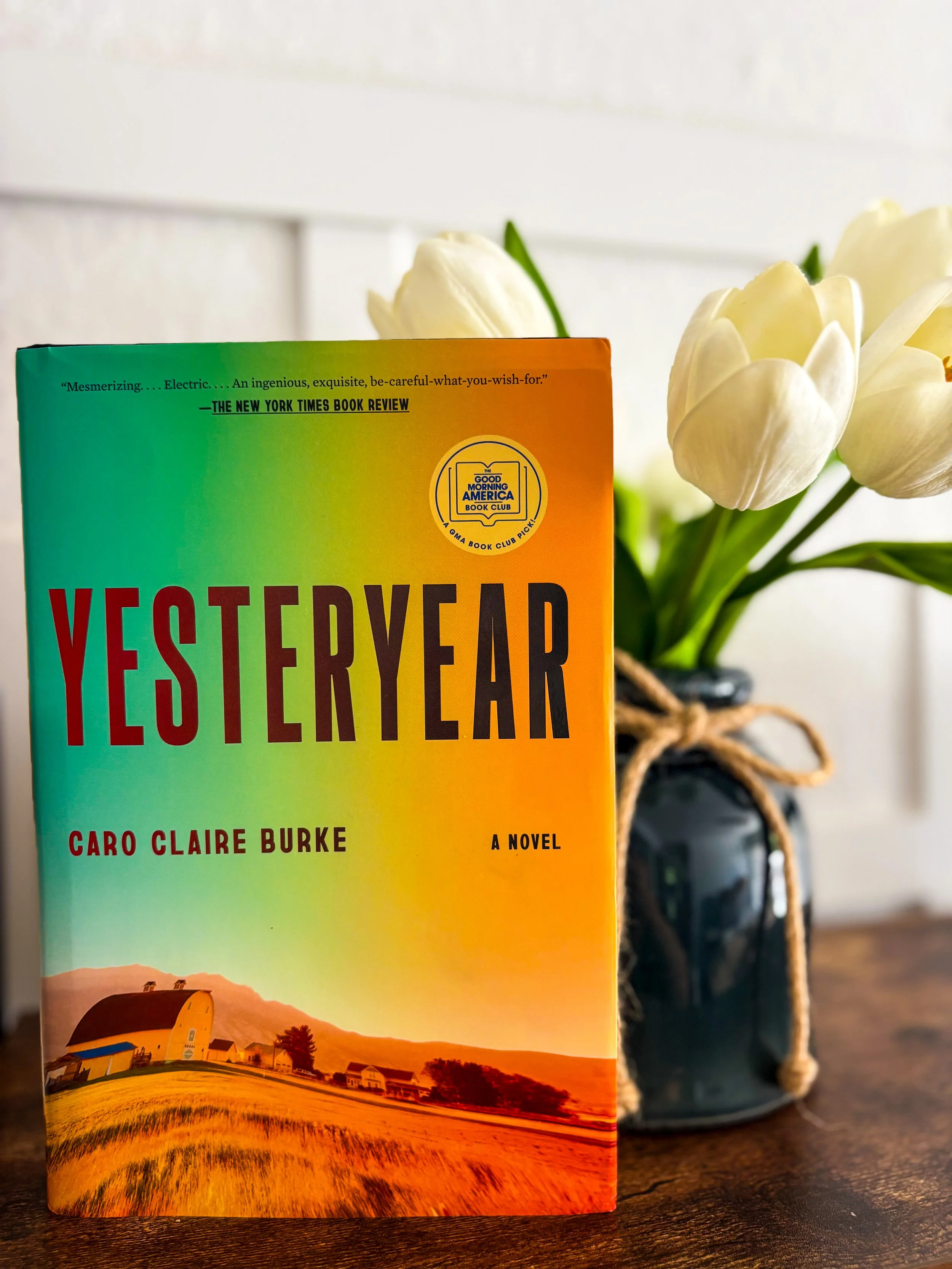
Spoilers for the whole book
Yesteryear by Caro Claire Burke Book Review
This book came out of nowhere. Nowhere and yet everywhere at the same time.
My friend and the librarian at my school (and fellow Love Island USA Season 8 watcher) recommended it with the kind of enthusiasm that is very hard to ignore when it's coming from someone whose taste you trust, which is very unusual. There are very few people’s book recommendations that I trust, but she has it nailed.
A tradwife protagonist was not exactly leaping off the shelf at me. I’ve read some heavy books lately and was looking for something lighter. A summer romance read, perhaps. A beach read. A pool read.
Yesteryear is certainly not that. However, I still immensely enjoyed it.
Natalie Heller Mills is thirty-two years old, six months pregnant with her sixth child, and one of the most successful Christian lifestyle influencers on the internet.
She runs Yesteryear Ranch, a five hundred acre property in rural Idaho, where she posts sourdough tutorials and family dinner tableaus to eight million followers who believe she is the living embodiment of traditional womanhood.
The aesthetic is immaculate. The life underneath the aesthetic is not.
Beneath the gingham and the cast iron and the carefully lit farmhouse kitchen, Natalie privately scorns her followers, manages her husband Caleb like a political liability she is perpetually cleaning up after, and has been fully aware that Caleb and her twenty-one year old producer Shannon are sleeping together long before Caleb works up the nerve to tell her.
She is calculating and pugnacious and brilliant and extraordinarily unpleasant, and she is one of the most compelling narrators I've read recently.
The Nara Smith and Ballerina Farm parallels are obvious enough that Burke doesn't bother obscuring them (Caleb is a senator's son, a deliberate echo of Hannah Neeleman's JetBlue heir husband Daniel Neeleman, because Burke is not here to be coy about her targets). What makes Natalie interesting beyond the cultural reference points is that she is not oblivious.
She is not a woman who stumbled accidentally into tradwife influencing because she genuinely believed in it. She saw an audience, identified what they wanted, and built a product to serve it.
The fact that the product happened to be her own children's childhoods and her body and her marriage is the entire point. Burke makes sure you feel the full weight of that without ever letting Natalie wallow in self-pity about it.
There is no redemption arc here (thank god, honestly). There is just Natalie, burning everything down and watching it go with a kind of cold fascination that I found genuinely riveting to be inside of.
Reading this book is like watching a car crash in slow motion. You know it's going badly. You can see exactly where it ends. I could not stop reading anyway.
I picked it up and essentially did not put it down, which I say sometimes as a figure of speech and mean here as a literal description of my week (I’m on summer as a reminder, I have the luxury to do this).
The modern storyline is propulsive and sharp and so deeply, specifically weird in the way that our modern world full of social media is complex and confusing.
Burke clearly knows this world from the inside out: the way the algorithm rewards performance over authenticity, the way a men's rights livestreamer handed Natalie her first three hundred thousand followers overnight by praising her as a "real woman," the way Shannon's betrayal lands as simultaneously completely understandable and still a gut punch.
All of it feels real because all of it essentially is real, just slightly rearranged.
Here is where I get complicated, though, and I have a lot to say so I'm going to take my time.
The dual timeline is the book’s biggest structural problem and my primary frustration with it.
The premise works like this: alongside the contemporary backstory of how Natalie built and simultaneously destroyed her empire, the novel alternates with a present-tense storyline in which Natalie wakes up in what appears to be 1855, trapped in a pioneer version of Yesteryear without electricity or running water or any of the modern conveniences she has spent years performing her rejection of for Instagram.
She has four unfamiliar children. An older, more menacing version of Caleb who hits her when she tries to run. Zero explanation.
Burke's intent is legible. The 1855 sections are meant to literalize the fantasy Natalie has been selling, to strip the tradwife aesthetic of its filter and show what it actually looks like: hauling firewood, handwashing laundry until your fingers bleed, dirty children who work like small adults and have never seen a doctor.
The comparison between what Natalie advertised and what Natalie actually had to survive is the argument, and it is a coherent one.
It just did not work for me in practice.
The modern storyline is already so tense and so fascinating that the 1855 breaks interrupt its momentum rather than building on it. Every time I was deeply embedded in Natalie's contemporary unraveling, the narrative yanked me back to pioneer Idaho, and I found myself impatient in a way I was never impatient during the present-day sections.
The tension was already there. It did not need the counterweight.
I think Yesteryear would have been a significantly stronger and more focused book as a pure contemporary psychological portrait, following Natalie's rise and collapse without the speculative timeline, and I say that as someone who is generally willing to go along with structural risks when they're earning their keep. This one wasn't it, for me.
Then you get the reveal.
I could go on and on but the short version is that the 1855 world is neither time travel nor a reality show. It is the result of a total psychological break, one so complete and so prolonged that Natalie essentially forgot she had built it, which means the book's most interesting argument, that Natalie was a willing and calculating architect of her own ideology and its consequences, quietly collapses in the final act.
Reframing her as primarily a victim of Caleb's manipulation and her own fractured mind is not entirely wrong (she is both things, and the book knows that), but it lets her off a hook it spent three hundred pages putting her on.
The tradwife-as-victim framing is more comfortable than the tradwife-as-willing-participant framing, and comfort is exactly what this book should not be going for. It is the safer choice, and it costs the novel heavily.
Also, she walks away with Caleb at the end. Hand in hand. This is the woman who spent the entire novel barely concealing her active contempt for him.
I understand what Burke was going for narratively. I understand it and I still found it baffling and I am still annoyed about it two weeks later, which I suppose means the book is living in my head exactly as intended even while frustrating me because it could have been even better as a debut novel.
Despite all of that, and I want to be clear that the frustration is real, Yesteryear gave me a reading experience I haven’t had in a while. A perspective I hadn’t encountered before. That’s harder to find than it sounds, especially at this point in my reading life, and Burke delivers one with real confidence for most of this novel.
Natalie is infuriating and fascinating and the type of narrator you resent even as you need to know what happens to her next. The contemporary storyline alone would have scored higher. The ending brought it lower than it could have been.
Recommendation: What an utterly fascinating read with so much promise. Go in knowing that the ending doesn’t quite land, allow the confusion of the 1850’s storyline to wash over and out of you, but still hold out. Grab a front row seat for this total car crash experience and enjoy every page.
Score: 7/10


